


Was there a certain amount of bullying do you think? Oh gosh yes, absolutely there was a certain amount of bullying went on. I mentioned the newsroom earlier on and certainly when I first joined in terms of the producer and the news editor were all females. It was quite interesting that because they were…
Read More
Ian Hunton describes his work as an online editor
I never did film editing. All the editing then was called ‘online editing’. It was traditional. Because the online editing suite was so complicated – with videotape machines and the mixers – it was generally accepted that the people who got those jobs were ex-engineers. I decided after I’d had eighteen years doing the engineering…
Read More
Wallen Matthie describes the support that Granada offered its employees
At my interview one of the things that was said to me was that you were entering into this family. And it was a family. I did feel that. People were really supportive. You could go to most of the senior people, producers. The fact that it wasn’t Mr Plowright, it was David, and he…
Read More
Joan Riley on how she came to be employed at Granada
There was an advert in the Evening News for a fast typist for the Granada Newsroom. I applied and was asked to go for an interview; a typing test. This was 1960. At that time the main building hadn’t been finished, so all the offices were opposite Granada in Quay Street in an old warehouse.…
Read More
Joan Riley remembers working in the Promotions Department – and meeting Pat Phoenix
Promotions department; the duty announcer would give a run down of all the programmes for that night and would pick out the special ones, do a few more words on that. And the scriptwriters would write these small scripts out, minute long for the afternoon and evening, and we typed them out. We’d get black…
Read More
Joan Riley remembers the variety of performers on ‘Scene at 6.30’
A lot of the performers would come down chatting to us in-between, because we were permanent staff there. One day a little red headed girl, very small, about sixteen, Scottish. She came and was chatting away with us and they decided she would rehearse her song at our end. I was very grateful I had…
Read More
Joan Riley remembers the famous incident when Bob Greaves met an elephant
We had a photo call for the zoologist, Desmond Morris, who did a lot of programmes for Granada. There was a photo call for him in Chester zoo, and it was a good turn out, all the journalists, reporters and photographers were there. Each one of them trying to get an exclusive; an exclusive photograph,…
Read More
Joan Riley recalls how Granada covered the assassination of President Kennedy in 1963
They decided they were going to have a new magazine called ‘Scene at 6.30’. So the whole of the newsroom was transported to the fifth floor; it was a large studio there. From the lifts you turned right and it was the whole of the floor, a very large area for the directors and researchers…
Read More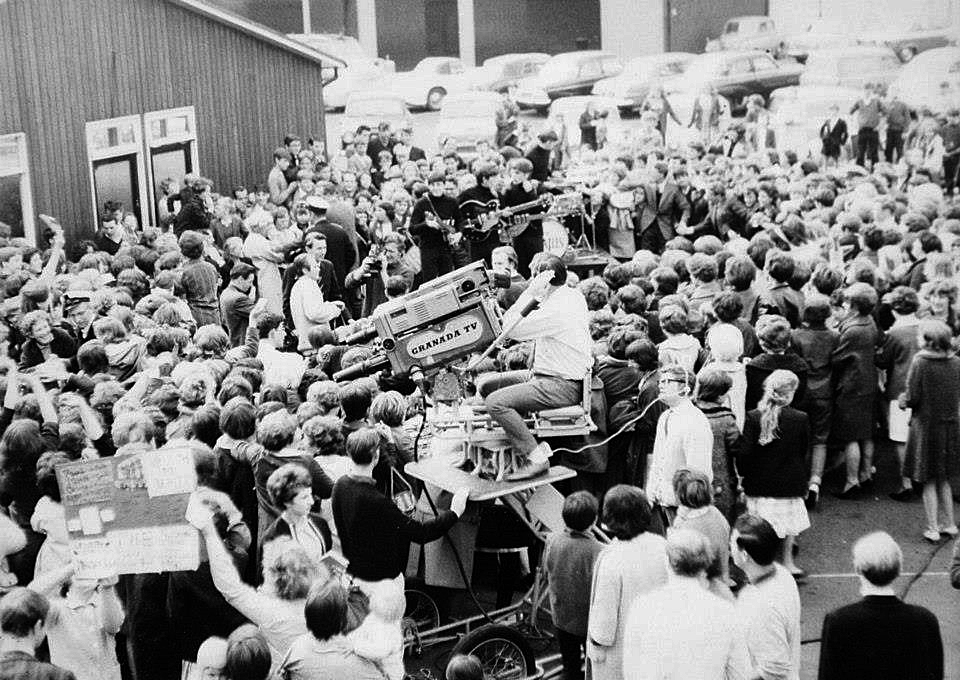
Joan Riley meets the Beatles
They were going to have a late news bulletin so Joyce and I did split shifts. One week we’d have two days 10-6 and three days 6-11 and then swap round. Promptly at 8 o’clock every night we’d get the empty flask and go to the canteen for refills to keep us going. One night…
Read More
Joan Riley remembers a union dispute about appearance fees
It was decided to have ‘Scene’ at 11 o’clock as well. So we all went back to Quay Street side, directly above where the original newsroom had been, a very large area. At the far end was the studio. I don’t know whether you remember it but the studio was partitioned off with a large…
Read More
Joan Riley describes her impressions of Granada as a company
Was Granada a paternalistic company? I think so and unfortunately I think the unions, in a way, stopped a lot of that because we used to get two bonuses one in May and one in October. There was one strike so they stopped one bonus and then another strike and they stopped another bonus. They…
Read More
Janice Finch on working as a documentary researcher in the 1980’s and her first meeting with Ray Fitzwalter
I did a whole stint for about five years working on network documentaries and I had to work out of London. I worked initially on a programme with Simon Berthon who had worked on ‘World in Action’ and we made this film about desertion amongst airmen in World War Two. That was absolutely fascinating because…
Read More
Brian Blake talks about the different mix of staff that worked on ‘World In Action’
The team was always incredibly small, maybe sixteen, seventeen, eighteen of which eleven or twelve were producers, so about six researchers. We tended to get all the bread and butter stuff, the hard graft of hitting the phone and knocking on doors. Very rarely did you get abroad, all that began to happen much later…
Read More
Sandy Ross on how he was first employed by Granada
How did you actually come to work for Granada, because I know that Granada didn’t always take people who were obvious like journalists? It’s quite difficult to try and understand but I think I was part of the working class phase because you’re absolutely right, they had quite an eclectic hiring policy. Sometimes they would…
Read More
Janice Finch talks about the size of documentary film crews in the 1980s
So my first taste of programmes was helping out one weekend on a mammoth documentary Granada was making about the Liverpool-Everton Milk Cup Final in 1984. That was my first taste of working with a documentary crew and I remember on that occasion there were eight people. Wherever you went filming, even in people’s living…
Read More
Janice Finch recalls how she got to work on ‘World In Action’
I’d done this programme I was telling you about on airmen and desertion in World War Two, then I’d worked for eighteen months on a series about how the world was mapped called ‘The Shape of the World’. That sent me all over the world, amazing to think now, and was sponsored by IBM, so…
Read More
Janice Finch talks about the shift from film to tape and how it impacted on ‘World In Action’
This was a massive transformation as I said, where before they used to have eight people working on things with film this was now a three-man crew. I should say three person crew but I don’t think there were any camerawomen or sound recordists at the time I worked at Granada. It did mean I was…
Read More
Janice Finch recalls her pride in working at Granada
I felt incredibly proud to work there, not least because I had grown up in Manchester, so I’d always seen the building and I was familiar with its programmes. I used to think it made programmes I would want to watch; intelligent programmes. Yes they did the whole gamut of entertainment and drama and so…
Read More
Janice Finch on Granada as a company
I always felt that it was small enough so people knew who you were. What I also loved, that even before the Internet and people sending emails to people left right and centre, you could send notes to those in authority. The line of command at Granada was really short. So you could see Denis…
Read More
Janice Finch on the importance of Granada TV to the North West
It was such a big deal, the Beatles being there. (in 1963) You did feel, you really did feel at the time that the North and the North West was on its way and Granada was all part of that. Did you see Granada as being important to the North West? Yes, you saw that…
Read More
Brian Blake talks about the working atmosphere on ‘World In Action’
What about women who worked on the programme (‘World In Action’)? There weren’t many at all, especially the early days. Most of them were single, tough in that sense because they had to be, it was an incredibly male society. It was funny it was different, they were very sensitive filmmakers, very good at emotional…
Read More
Janice Finch talks about Sidney Bernstein
I had to work on preparing the obituary of Sidney Bernstein at one stage, when I was working at Granada, when he was not well. Immediately we were asked to go and interview people who had been key in his life. I had to read up a great deal about him and how the company…
Read More
Janice Finch remembers working on the Channel 4 programme ‘Union World’ made by Granada TV
‘Union World’ was a very good grounding if you wanted to work in current affairs. Obviously it was at a time when trade union politics were very important in Britain. In fact I’d barely started working at Granada when the miners’ strike began. That kind of dominated the time I worked on ‘Union World’, which…
Read More
Janice Finch remembers the Granada canteen
I remember standing in the queue at the canteen behind this short bloke and thinking ‘I know you from somewhere’ and as he turned to pay I recognised it was Roger Daltrey. I thought ‘My god, what is he doing here?’ It was the kind of place where you’d be sitting there having your fish…
Read More
Janice Finch talks about being a woman working in television
I guess I’ve never ever considered whether or not my gender would hold me back. It never entered into it. Television, compared with other walks of life, has never felt to me like an area in which women couldn’t get ahead. In the time I worked there we had a director of programmes, Andrea Wonfor,…
Read More
Brian Blake talks about working on the ‘World In Action’ programme that covered the first British Gay Pride rally in London in 1972
It was the first gay rights civil march in London, to Hyde Park on a Saturday. We had two crews out, one followed a group of gay rights people from Liverpool and I went down to London and filmed the equivalent London group of people who were marching to Hyde Park. So it was filmed…
Read More
Brian Blake on how Granada was run as a company
And there was an ability in those early days, was there not, to be able to come up with an idea one minute and by the afternoon be actually making the programme? It was exactly the same as I was saying earlier about picking people on a flair; ideas were the same. There were no…
Read More
Brian Blake remembers Denis Forman
When I came to Manchester, I had never been to Manchester before apart from playing football in university days, but I had never been to Granada. I went to the desk and asked “Can I see Denis Forman?” They looked at me, “Is he expecting you?” I said “Yes he is.” I didn’t realise he was…
Read MoreThe Bernsteins, Denis Forman and David Plowright
Sidney Bernstein (1899-1993) was undoubtedly the inspiration and driving force behind Granada Television. Before the Second World War he created the London Film Society and was responsible for bringing all the Eisenstein classics to the UK for the first time. He formed a close friendship with Alfred Hitchcock and at the end of the war…
Read More
Brian Blake remembers Sidney Bernstein and his film about the Belsen concentration camp
I had just finished the ‘History of Television’ and Steve Morrison rang me up and said “Sidney wants this film made.” I said “Oh yes” In the Second World War Sidney was one of the first people to go into Belsen concentration camp. He was a major in the army and he decided when he…
Read More